Air-To-Air Film Of The 504k

-
Preserving and Recording Audio-Visual History
Developed by A.V. Roe and Company (Avro) in the United Kingdom, the 504 biplane first flew in 1913 and quickly established itself as a pivotal aircraft in both military and civilian aviation sectors. Originally designed as a reconnaissance and light bomber aircraft for the military, the Avro 504K's robust design and ease of handling made it an ideal training aircraft, a role in which it achieved considerable fame during and after World War I.
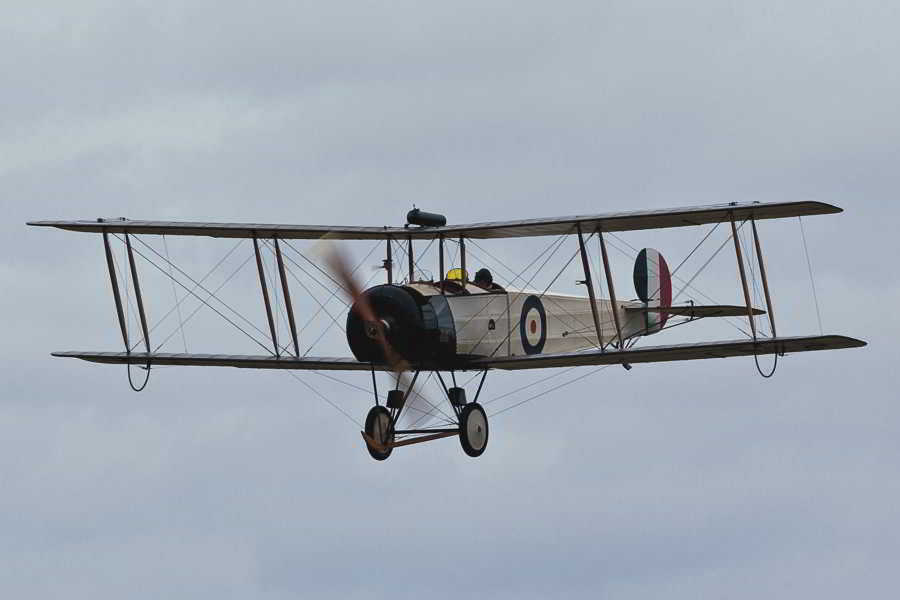
An original Avro 504k sporting a generic 1914 Royal Flying Corps colour scheme
Photo: © Historical Aviation Film Unit
Year: 1913 Built: 8,970 Top Speed: 145 km/h Wingspan: 10.979m Height: 3.17m Length: 8.97m Max Weight: 830kg Engine: 110-130hp Clerget rotary Ceiling: 4,875m Climb: 3.6m/s Range: 402km Endurance: 165 mins Armament: Provision for four 9kg Cooper bombs This Aircraft: A restored original airframe with an original 100hp Gnome 9-cylinder rotary engine.
The Avro 504K was distinguished by its simplistic yet effective design. It featured a conventional biplane layout with a single engine, two open cockpits, and a fixed tailskid undercarriage. Initially equipped with various rotary engines, including the famous Gnome Monosoupape engine, later versions of the 504K were commonly fitted with the more reliable and powerful 130 hp Clerget rotary engine. This powerplant provided the aircraft with a modest top speed of around 82 mph (132 km/h) and a service ceiling of approximately 13,000 feet (4,000 meters), making it suitable for a variety of roles.
In its military capacity, the Avro 504K played a crucial role in training thousands of pilots for the Royal Flying Corps, and later, the Royal Air Force. Its stable flight characteristics and forgiving nature made it an excellent platform for novice pilots to learn the basics of flight. During the war, it also saw action as a light bomber and reconnaissance aircraft, though it was primarily superseded in these roles by more advanced aircraft as the war progressed.
After the end of World War I, the Avro 504K's legacy continued to grow. It became one of the most popular aircraft for flying clubs and private owners, contributing significantly to the development of civilian aviation in the UK and beyond. Its ease of maintenance and operation made it an ideal choice for flying schools, where it continued to serve as a trainer well into the 1920s and 1930s. The Avro 504K not only played a pivotal role during a critical period in aviation history but also laid the groundwork for the development of pilot training and general aviation in the years following the war.
The Vintage Aviator Ltd's original (restored) Avro 504 is shown here during a display at an airshow in New Zealand.
The 504 is a significant part of aviation history in New Zealand. Of the twenty 504s supplied to NZ by Britain in 1920, 18 were loaned to commercial companies who were beginning the post-war development of aviation (the other two were retained by the Government). Later, the New Zealand Permanent Air Force re-acquired some of these aircraft, as well as purchasing six more, and used them throughout the remainder of the 1920s as training aircraft.
In August 1920, Capt Euan Dickson (a WW1 ace) used a 504 to make the first aerial crossing of Cook Strait between New Zealand’s North and South Islands), starting from a field just outside Blenheim.

Renowned UK warbird pilot Stu Goldspink takes the original Avro 504k for a spin over the Wairarapa countryside Photo: © Historical Aviation Film Unit
This aircraft is one of the most historic original aircraft surviving in New Zealand. This 504 has been flown (as recorded in the aircraft’s original log books) by such pioneer aviators as Chichester, Hood, Moncrief, McGregor and the Australians, Kingsford-Smith and Ulm.
More Videos:
Air-To-Air Film Of The 504k
504 Take-off and Fuel Burn
Avro 504k and B.E.2c
A 504k Replica At Omaka
More Photos:
Share This Page :
If you sign up to be a Member on our Historical Aviation Film Unit channel then you'll have immediate access to this extra material. Click the button at right, then on our channel page click the 'Join' button - it'll help us immensely.
Please consider subscribing to HMTV, or buy us a drink to support our historical (story and film) preservation endeavours.
Copyright © All Rights Reserved — Historical Aviation Film Unit
Template by OS Templates


