A B.E.2c and B.E.2f At Wings Over Wairarapa

-
Preserving and Recording Audio-Visual History
Developed by the Royal Aircraft Factory, a government establishment in Farnborough, England, the B.E.2c was an evolution of the earlier B.E.2a and B.E.2b models. Introduced in 1914, this biplane was designed primarily for reconnaissance and light bombing roles, and it was characterized by its stability and relatively good handling, which made it an ideal platform for observation and artillery spotting tasks. Its construction was typical of the period, featuring a wooden frame covered with fabric, and it was equipped with a reliable but underpowered RAF 1a engine that produced around 70 horsepower.
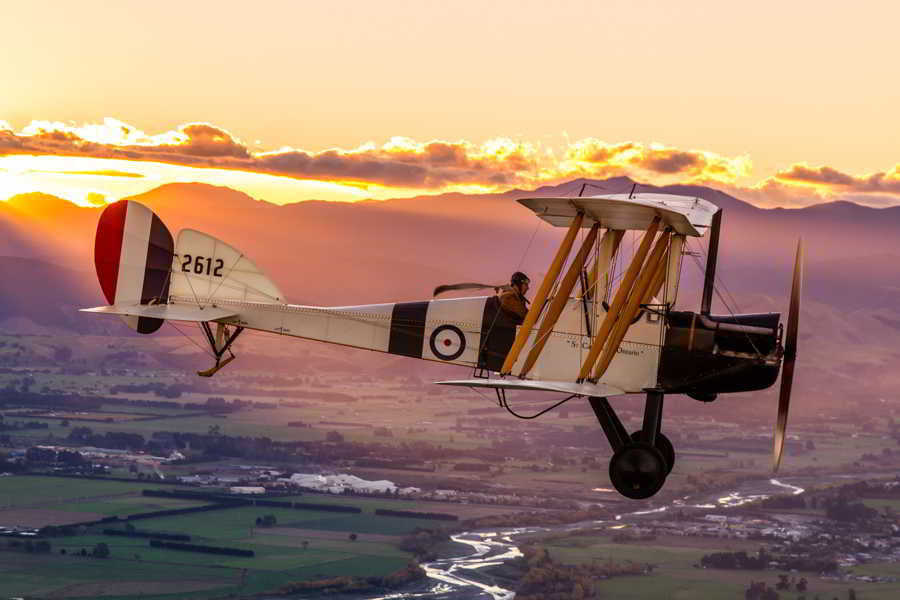
Royal Aircraft Factory B.E.2c in the colour scheme of '2612' of No. 16 Squadron, Royal Flying Corps.
Photo: © Historical Aviation Film Unit
Year: 1914 Built: 3500+ (all B.E.2 variants) Top Speed: 116 km/h Operational Ceiling: 3,048m Wingspan: 11.28m Height: 3.4m Length: 8.31m Engine: 70hp Renault air cooled V-8 Range: 300km Endurance: 195 mins Armament: Swing mount for 1 x .303 Lewis machine gun, up to 45kg bombs This Aircraft: A new TVAL built reproduction aircraft with a new reproduction RAF1a v-8 engine
The operational role of the B.E.2c was crucial in the early war years, especially in the absence of more advanced aircraft. It was one of the first aircraft to be used for both offensive and defensive operations, including bombing raids, photographic reconnaissance, and as a defensive fighter against German Zeppelins. The B.E.2c's stability, while an advantage for reconnaissance, made it vulnerable in air-to-air combat. As the war progressed and more agile and better-armed German aircraft entered service, the B.E.2c increasingly found itself outmatched. Its slow speed and lack of defensive armament made it an easy target, earning it unflattering nicknames from its crews.
The colour scheme on this aircraft represents that of a 'Presentation Aircraft' which was sponsored by St Catharines in Southern Ontario, Canada (note that the incorrect spelling of the city on the fuselage is accurate, as photographic evidence shows that this is how it was applied to the original aircraft in 1916).
Little else is known about the aircraft other than the fact that it served in France with No 16 Squadron. The unit was first formed at St Omer in early February 1915 and used a variety of aircraft such as the R.A.F. R.E.5, the Vickers F.B.5 and the Voisin III, before it was equipped with R.A.F. B.E.2c's later in the month. The B.E.2's began operations in March 1915, and some were still in service with the unit as late as May 1917. Reports indicate that '2612' was reported as 'missing' on the 1st of June 1916.
This is a short air-to-air video clip of two early Royal Flying Corps aircraft - the Avro 504k and the Royal Aircraft Factory B.E.2c. This 504k is an original aircraft with original rotary engine. The B.E.2c is a (another) new-built example produced by The Vintage Aviator Ltd.
The two black bands around the aircraft fuselage (either side of the roundel) were standard markings for No 16 Squadron. On the earlier clear doped aircraft such as this one the bands were painted black, whereas on later aircraft that were painted in the darker PC.10 colour the two bands were painted in white.
In mid July 1915 the initial Commanding Officer of the Squadron (Major H.V. Holt) was replaced by Major Hugh C.T. Dowding, who commanded the unit through until January 1916. Twenty four years later Dowding would become famous as Air Officer Commanding RAF Fighter Command during the Battle of Britain, and he's generally credited with playing a crucial role in Britain's defence during this part of World War 2.

An aerial view of the Royal Aircraft Factory B.E.2c Photo: © Historical Aviation Film Unit
Despite its vulnerabilities, the B.E.2c played a significant role in the development of aerial warfare tactics and aircraft design. Its widespread use helped to establish the importance of aerial reconnaissance and control of the air in modern warfare. Additionally, the experiences gained from operating the B.E.2c informed the development of later, more capable aircraft designs. By the time it was phased out in favor of more advanced models, the B.E.2c had served as a workhorse of the Royal Flying Corps and had laid the groundwork for the future of military aviation.
More Videos:
A B.E.2c and B.E.2f At Wings Over Wairarapa
Four Reproduction B.E.2's Together
More Photos:
Share This Page :
If you sign up to be a Member on our Historical Aviation Film Unit channel then you'll have immediate access to this extra material. Click the button at right, then on our channel page click the 'Join' button - it'll help us immensely.
Please consider subscribing to HMTV, or buy us a drink to support our historical (story and film) preservation endeavours.
Copyright © All Rights Reserved — Historical Aviation Film Unit
Template by OS Templates


