Spitfire At RNZAF's 80th Birthday Party

-
Preserving and Recording Audio-Visual History
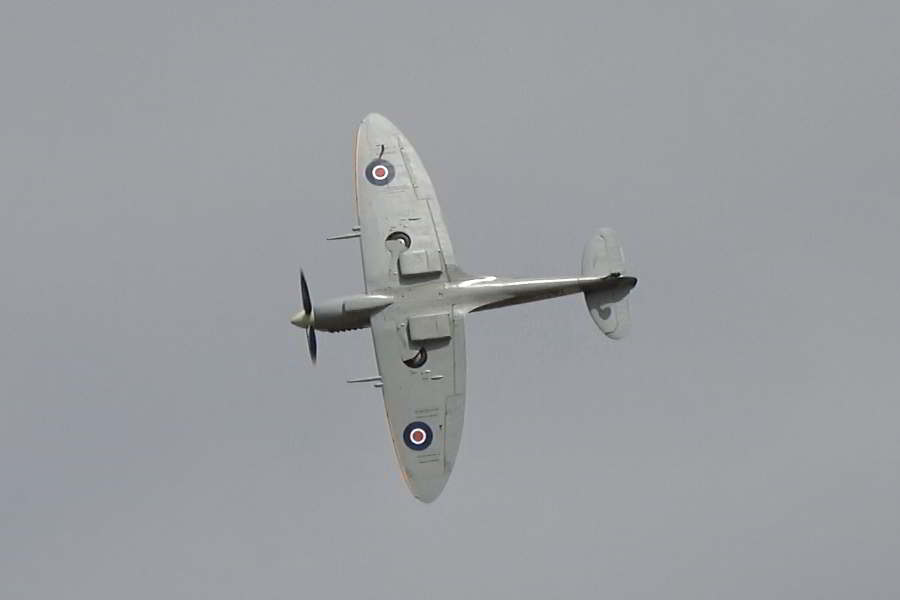
Designed by RJ Mitchell, the Supermarine Spitfire first flew in 1936, and went on to become one of the most iconic and revered fighter aircraft in military aviation history. Renowned for its sleek design, high performance, and exceptional agility, the Spitfire was powered by the famous Rolls-Royce Merlin engine, which contributed to its superb aerial capabilities. Its elliptical wings, a distinctive feature, not only contributed to its aesthetic appeal but also enhanced its aerodynamic efficiency, allowing for higher speeds and greater maneuverability. The Spitfire's versatility was evident in its numerous variants, each designed for specific roles, including interception, photo-reconnaissance, and even as a carrier-based aircraft.

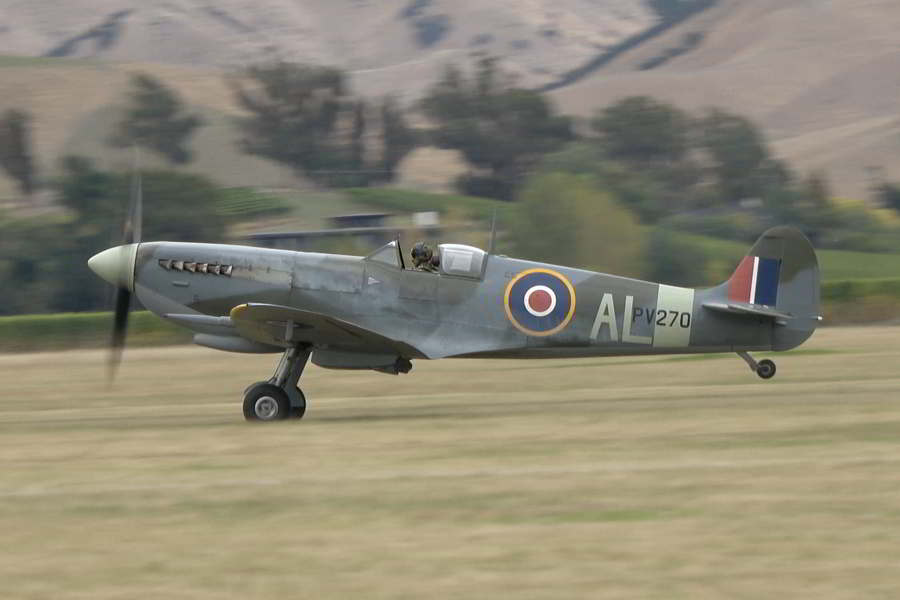
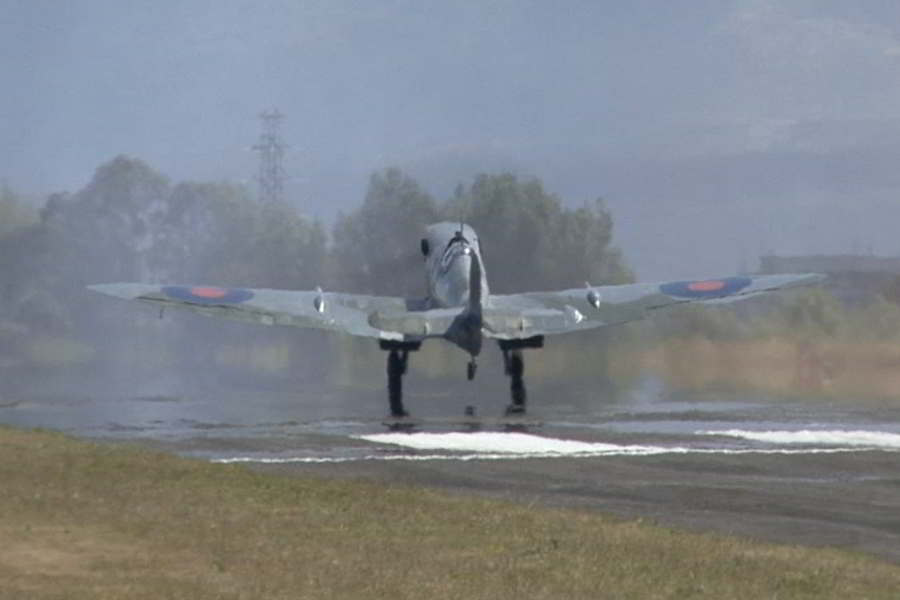
Spitfire PV270 lands on a grass strip, just like she would likely have done during her service in WW2.
Photo Supplied
Year: 1936 Built: 22,000+ (5,656 Mk.IX) Serial: PV270 Registration: ZK-SPI Top Speed: 650 km/h Wingspan: 9.93m Height: 3.86m Length: 9.47m Engine: 1,710hp Rolls-Royce Merlin 70 V-12 inline Ceiling: 11,125m Range: 2,575km Armament: 2 × 20mm Hispano Mk II cannons and 2 × 0.50in M2 Browning machine guns
Proven over the beaches of Dunkirk, the Spitfire went on to become a key fighter in the Battle of Britain and maintained its position as a frontline fighter throughout the Second World War. It was used in a wide range of roles from fighter, bomber escort to photographic reconnaissance and in all 22,000 Spitfires were built. Early marks were powered by the Rolls Royce Merlin while later models used the powerful Rolls Royce Griffon.
This Mk.IX was built at Castle Bromwich in Sept 1944 and served in the final stages of the war with the RAF in northern Italy. Post war it served with the Italian Air Force before being sold to the Israeli Air Force. After three years in Israel it was sold to the Burmese (Myanmar) Air Force and refurbished for use in their border war with the Nationalist Chinese. Its final flight was in July 1956 and it then spent 26 years as a gate guardian at a Burmese Air Force Base.
Restoration of PV270 began in 2003 at Taonui Aerodrome and its first post restoration flight occured on March 18th 2009. The aircraft is painted in the marking of well-known New Zealand-born Battle of Britain Spitfire pilot, Alan Deere. While the RNZAF never operated Spitfires itself, a large number of RNZAF trained pilots flew them during WW2 with the Royal Air Force in Europe and North Africa. There was even a special squadron in the RAF, No 485 (NZ) Sqn, that was largely staffed by New Zealanders and flew Spitfires.
Follow and support the Spitfire and other Biggin Hill aircraft "here on their website."
Brendon Deere, the nephew of famed WW2 Spitfire Ace Al Deere, at his Biggin Hill Historic Aircraft Centre at RNZAF Ohakea in New Zealand, talks to HAFU about the Spitire, his Grumman Avenger, and the aircraft centre.
Group Captain Alan Christopher Deere, DSO, OBE, DFC & Bar, was a distinguished fighter pilot in the RAF, renowned for his remarkable skill and bravery. Born in 1917, Deere's aviation career became particularly notable during the Battle of Britain, where he flew the iconic Spitfire. His exceptional airmanship and combat prowess were demonstrated through numerous aerial engagements, leading to significant recognition and several decorations. Deere's experiences, recounted in his autobiography "Nine Lives", offer a vivid and personal perspective of the life of a fighter pilot in one of history's most pivotal aerial conflicts. His story is not just one of personal courage and skill, but also a testament to the international contribution to the RAF's efforts during World War II.

View of the Spitfire over the Whanganui River, New Zealand. Photo: © New Zealand Defence Force
After World War II, Deere continued his distinguished career in the RAF and contributed significantly to military aviation in various capacities. He served as a station commander at various RAF bases, where his position involved overseeing the operations of the base, training, and welfare of personnel, and maintaining high standards of operational readiness.
In the 1950s, he played a significant role in the North Atlantic Treaty Organization (NATO). He was appointed as the Senior Air Staff Officer at the Headquarters of the Second Tactical Air Force in Germany. This position involved significant responsibility, overseeing air operations and strategy during a critical period of the Cold War. Deere finaly retired from the RAF in December 1967.
More Videos:
Spitfire At RNZAF's 80th Birthday Party
Display Of The Spitfie Mk.IX At Low Level
Two Spitfire 'Nines' In New Zealand
Two Spitfire 'Nines' At Warbirds Over Wanaka
More Photos:
Share This Page :
If you sign up to be a Member on our Historical Aviation Film Unit channel then you'll have immediate access to this extra material. Click the button at right, then on our channel page click the 'Join' button - it'll help us immensely.
Please consider subscribing to HMTV, or buy us a drink to support our historical (story and film) preservation endeavours.
Copyright © All Rights Reserved — Historical Aviation Film Unit
Template by OS Templates