Venom Display At Ardmore During DDay Show

-
Preserving and Recording Audio-Visual History
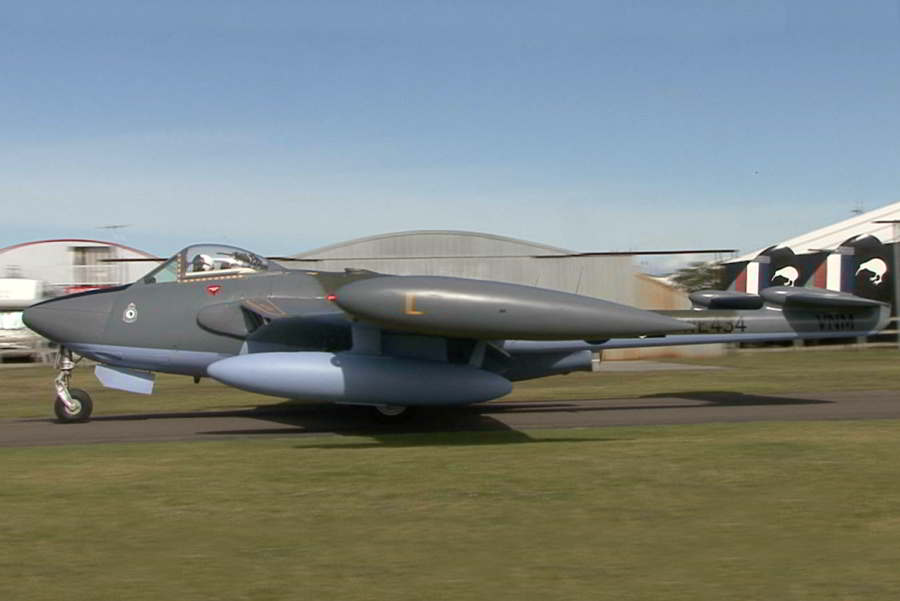
First flying in 1949, the Venom is a British post-war jet fighter-bomber developed by de Havilland and was designed as a successor to the de Havilland Vampire, one of the pioneering jet fighters. Similar in looks to that earlier type and originally referred to as the Vampire FB.8 (for fighter-bomber), the Venom was in fact an all new design featuring many significant improvements including better aerodynamics, a more powerful de Havilland Ghost turbojet engine, and an ejection seat, significantly enhancing its performance and pilot safety.

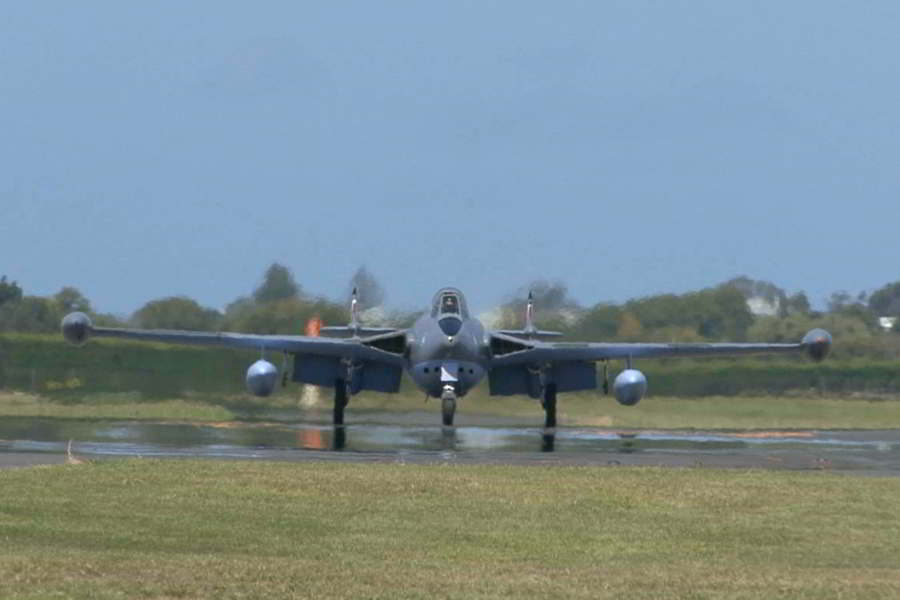
The Venom takes off at Ardmore Aerodrome in Auckland, NZ.
Photo: © Historical Aviation Film Unit
Year: 1952 Built: 1,431 Serial: 840 Registration: ZK-VNM Top Speed: 1,030 km/h Wingspan: 12.70m Height: 1.88m Length: 9.70m Engine: de Havilland GHost 103 centrifugal-flow turbojet Climb:46m/s Ceiling:12,000m Range: 1,740km Armament: 4 x 20mm (0.79in) Hispano cannon and 2 x 1000kg external bombs, plus up to 8 x 27kg RP-3 rockets
In August 1952, No. 11 Squadron RAF become the first overseas squadron to convert to the Venom in exchange for their existing Vampires. When they were first introduced to service none of the single-seat fighter-bomber Venoms were deployed to UK squadrons as priority was given to overseas forces, such as the Second Tactical Air Force stationed in Germany, as well as those in hotter climates where the benefits of the more powerful engine were most felt, such as Cyprus, the Middle East, Africa, and Asia.
Initially designed as a fighter-bomber, the Venom was remarkably versatile. It was used extensively in various roles including ground-attack missions and as a night fighter. Its adaptability was showcased in several conflicts, notably during the Suez Crisis in 1956, where it was used for ground-attack missions. This multi-role capability was a significant step forward in military aviation, reflecting a shift towards aircraft that could perform a variety of tasks effectively. This versatility saw the type serve not only with the RAF but also with several other air forces worldwide.
The Venom was one of the first aircraft to successfully use a swept wing design for high-speed performance. This design significantly improved the aircraft's aerodynamic efficiency at high speeds, especially near the speed of sound, and the swept wings also allowed for better handling and maneuverability at high altitudes which was a critical factor in jet fighter operations during the early Cold War era.
Venom display at Classic Flyers airshow in Tauranga, NZ.
This airframe was one of 250 built for the Swiss Air Force by the Federal Aircraft Factory (FAF) at Emmen and was allocated the Swiss serial number J1630 in 1956. By July 1984 it had been retired from service and was on the Swiss civil register, and first flew again in 1988 after a four year restoration.
A unique aspect of the Swiss Venoms was their adaptation to the specific requirements of operating in the mountainous terrain of Switzerland. This included modifications for improved performance and safety in such challenging environments, and this meant the Swiss Venoms were well-regarded for their reliability and effectiveness. They played a key role in the Swiss Air Force during their service life which extended into the 1980s, showcasing the durability and adaptability of the aircraft design.

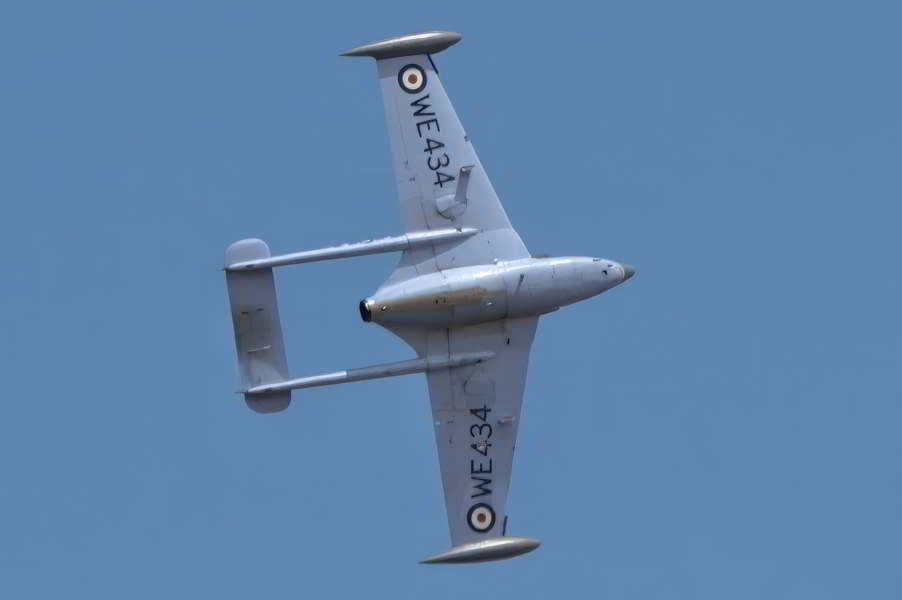
The overhead view of the Venom with its twin-boom tail is distinctive. Photo: © Historical Aviation Film Unit
This aircraft was imported to New Zealand in 2012 and is in the scheme of WE434, an aircraft that 14 Squadron RNZAF leased from the Royal Air Force in the 1950s during their deployment to Malaya. The RNZAF never owned any Venoms of its own, and 14 Squadron relinguished the aircraft when they returned to New Zealand.
More Videos:
Venom Display At Ardmore During DDay Show
Venom Display At Wings Over Wairarapa
Taxi And Take Off At RNZAF Woodbourne
P-51 Mustang & A Previous Venom In New Zealand
More Photos:
Share This Page :
If you sign up to be a Member on our Historical Aviation Film Unit channel then you'll have immediate access to this extra material. Click the button at right, then on our channel page click the 'Join' button - it'll help us immensely.
Please consider subscribing to HMTV, or buy us a drink to support our historical (story and film) preservation endeavours.
Copyright © All Rights Reserved — Historical Aviation Film Unit
Template by OS Templates